How Far Is 300 Feet? 16 Real Things That Are 300 Feet Long
Things that are 300 feet long surround us more often than most people realize. 300 feet equals about 91.44 meters, roughly the length of an American football field measured from goal line to goal line. Understanding how far is 300 feet gives you a practical mental ruler for judging distance, height, and scale in everyday life, whether you are picturing a building, an aircraft, or a stretch of open ground.
This guide walks through sixteen verified, real-world examples of things that are 300 feet long, along with unit conversions, a side-by-side comparison table, and answers to the most common questions people search for about this distance. Every figure below has been checked against a primary or authoritative source, and any figure that could not be confirmed precisely has been clearly flagged as an approximation rather than presented as exact.
Quick Answer
300 feet equals 91.44 meters, 100 yards, or 0.057 miles. It is almost exactly the length of an American football field’s playing area (excluding end zones), about the height of a 25- to 30-story building, and roughly half the height of Seattle’s Space Needle.
300 Feet Unit Conversion Table
| Unit | Equivalent to 300 Feet |
|---|---|
| Meters | 91.44 m |
| Yards | 100 yd |
| Inches | 3,600 in |
| Kilometers | 0.0914 km |
| Miles | 0.0568 mi |
| Centimeters | 9,144 cm |
How Long Is 300 Feet?
To visualize how far is 300 feet, picture an American football field. The playing field between the goal lines measures 100 yards, which is exactly 300 feet (the end zones add another 30 feet on each side, but the core field of play is the classic 300-foot reference).

Another way to picture it: line up three Boeing 737 aircraft nose to tail. Each 737 measures roughly 110 to 130 feet depending on the variant, so three of them together stretch close to 300 to 390 feet, giving you a rough sense of just how much runway and taxiway space commercial jets actually need.
How Tall is 300 Feet in Stories?
How tall is 300 feet in a building context typically translates to about 25 to 30 stories, using the common architectural rule of thumb of roughly 10 to 12 feet per floor. That places a 300-foot building well below true skyscraper territory (buildings over 1,000 feet), but it is still tall enough to dominate most city skylines and qualify as a genuine mid-rise landmark.

A 300 foot building often marks the line between a neighborhood mid-rise and a true downtown tower, and many mixed-use developments in that height range are built specifically to blend residential, retail, and office space at a scale that still feels connected to street level.
List of Common Things That Are 300 Feet Long
- Three Blue Whales
- End-to-End Statue of Liberty
- Football Field
- New York World Building (Pulitzer Building)
- Missouri State Capitol Width
- Two Airport Runways Side by Side
- Big Ben (Elizabeth Tower)
- Fenway Park’s Pesky Pole
- Half the Height of the Space Needle
- The Height of Niagara Falls About
- Three Fifths as Tall as the Great Pyramid of Giza
- About Seven Tenths as Tall as the Spring Temple Buddha
- Close to the Wingspan of an Airbus A380
- Slightly Wider Than a Nimitz Class Aircraft Carrier’s Flight Deck
- Roughly Three Fourths as Tall as the Heckscher (Crown) Building
- A 30 Story Mid Rise Building
Three Blue Whales End-to-End
Blue whales typically measure around 80 to 100 feet in length, making them the largest animals ever known to have existed. Line up three of them nose to tail, and you land close to 300 feet, which puts the scale of these ocean giants into sharp perspective.

How long is 300 ft in the context of nature’s largest creatures, it becomes clear here. Even a length that swallows a football field is dwarfed by the open ocean, a reminder of just how immense marine life can be.
End-to-End Statue of Liberty
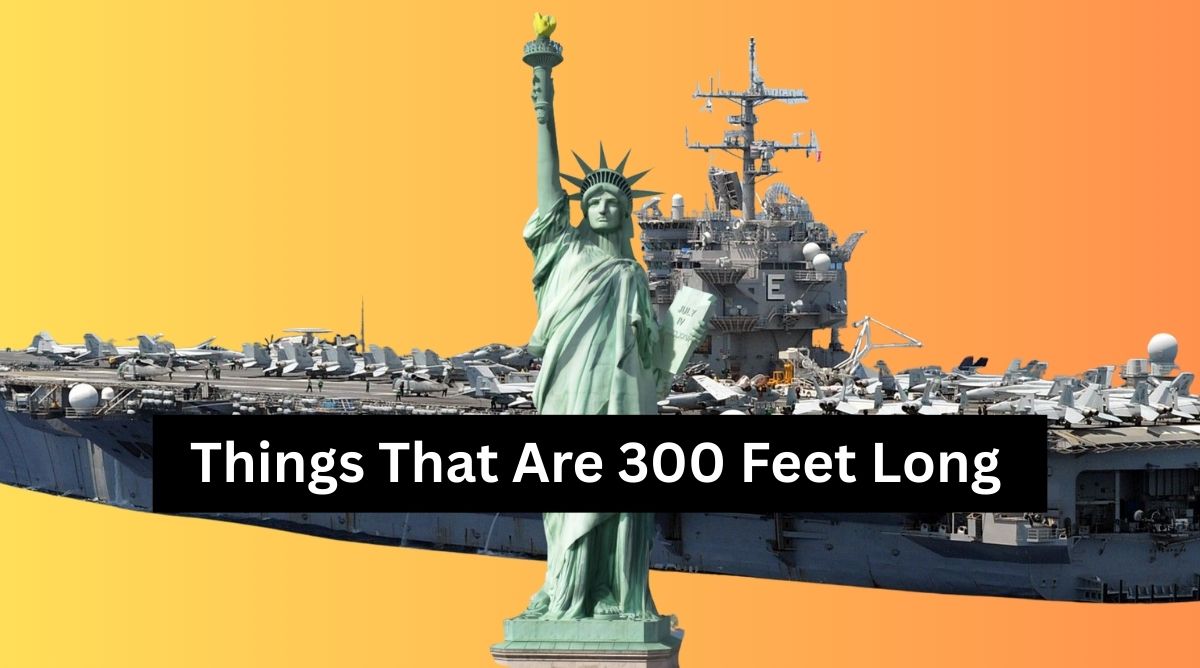
Standing 305 feet from the ground to the tip of the torch, the Statue of Liberty is one of the closest real-world matches to 300 feet on this list. It has stood in New York Harbor since 1886 as a global symbol of freedom.

Seen against the New York skyline, the statue’s true scale is easy to underestimate from a distance, but up close, every detail, from the flowing robe to the seven spikes of the crown, reflects the monumental engineering behind it.
Football Field
A football field’s playing area, measuring 100 yards or exactly 300 feet, is the most widely used real-world reference for this distance. It is the benchmark most people already carry in their heads without realizing it.

This makes how long 300 ft really is easy to grasp for most readers, and it explains why football fields show up so often as the default comparison for measurements in this range.
New York World Building (Pulitzer Building)
The Pulitzer Building, better known as the New York World Building, rose 309 feet from the street to the top of its gilded dome when it opened in 1890. It surpassed Trinity Church’s spire at the time, making it briefly the tallest building in New York City and the tallest office building in the world.

The building was demolished in 1955 to make way for an expanded Brooklyn Bridge entrance ramp, but in its era it changed how New Yorkers thought about vertical scale in city design.
Missouri State Capitol Width
The Missouri State Capitol in Jefferson City stands 437 feet long and 300 feet wide at its center, according to the building’s own official specifications. That width lines up almost exactly with the 300-foot mark, making it one of the most precise matches on this list.

Completed in 1917 and dedicated in 1924, the building’s dome rises 238 feet above ground level, but it is the 300-foot width that gives the structure its imposing, ground-level presence.
Two Airport Runways Side by Side
A single major commercial runway is commonly built to a standard width of about 150 feet under FAA design guidance for large aircraft. Two runways placed side by side add up to roughly 300 feet, giving planners enough separation and paved surface for safe taxiing, takeoff, and landing operations.

That extra paved width matters most during emergencies. If an aircraft experiences an engine issue or has to abort a landing, the additional margin can be the difference between a controlled outcome and a dangerous one.
Big Ben (Elizabeth Tower)
Standing 316 feet tall, the Elizabeth Tower, popularly known as Big Ben, has overlooked the Houses of Parliament in London since 1859. Its Gothic Revival design, credited to Augustus Pugin, makes it one of the most photographed clock towers in the world.
At 300 feet you would be standing just below the belfry, home to the Great Bell, which weighs roughly 13.7 tons and has marked London’s hours since it first rang in 1859.
Fenway Park’s Pesky Pole
Boston’s Fenway Park is famous for its short right field, where the foul pole known as the Pesky Pole sits just 302 feet from home plate, one of the shortest home run distances in Major League Baseball. It is among the most exact real-world matches for 300 feet you will find anywhere in professional sports.
A sharp curve in the outfield wall means many fly balls that look like certain home runs near the pole actually travel much farther before leaving the park, but the raw distance down the line remains one of the tightest matches to 300 feet in this entire list.
Half the Height of the Space Needle
Seattle’s Space Needle rises 605 feet above the city, making the halfway point almost exactly 300 feet. At that height on the tower, you would be roughly level with the base of the observation deck’s supporting structure, surrounded by the city skyline rather than looking down on it from the top.

The Space Needle opened for the 1962 World’s Fair and remains one of the most recognized silhouettes in American architecture, so using it as a scale reference tends to click quickly for readers who have never visited Seattle.
The Height of Niagara Falls
Niagara Falls is often cited with a Horseshoe Falls drop of approximately 167 feet and an American Falls drop of approximately 176 feet, though exact figures vary by source depending on where the measurement is taken and how much rock debris has built up at the base over time. Combined, a fall of close to 300 feet captures the general scale of the entire cascade rather than one exact figure.
Millions of gallons of water pour over the falls every minute, and the sound alone can be heard from a considerable distance, which is part of why the site remains one of the most visited natural landmarks in North America.
About Three Fifths as Tall as the Great Pyramid of Giza
The Great Pyramid of Giza originally stood about 481 feet tall and is now approximately 455 feet due to the loss of its outer limestone casing and capstone over thousands of years. Three hundred feet works out to a little over three-fifths of the pyramid’s original height, still a striking amount of stone and ancient engineering.

Few things that are 300 feet tall carry the same weight of history as a structure that has stood for over 4,000 years and remained the tallest human-made structure on Earth for roughly 3,800 of them.
About Seven Tenths as Tall as the Spring Temple Buddha
China’s Spring Temple Buddha statue stands about 420 feet tall on its own, not counting its 66-foot lotus pedestal, making it one of the tallest statues in the world. Three hundred feet comes out to roughly seven tenths of the statue’s height, a reminder of just how large the sculpture truly is.

Completed in 2008 in Henan Province, the statue represents years of construction and remains a major pilgrimage and tourism site in the region.
Close to the Wingspan of an Airbus A380
The Airbus A380, the world’s largest passenger aircraft, has a wingspan of about 261.8 feet, which is roughly 87 percent of 300 feet. Picture that wingspan stretching almost the length of a football field, supporting an aircraft capable of carrying close to 600,000 pounds at takeoff.
The scale of the aircraft is easy to underestimate from photographs alone, since its proportions are so balanced that the true size only becomes obvious when it is parked next to a smaller commercial jet.
Slightly Wider Than a Nimitz Class Aircraft Carrier’s Flight Deck
A Nimitz-class supercarrier has a flight deck width of about 252 feet, which means 300 feet is actually a bit wider than the deck itself rather than an exact match. It still gives a useful sense of scale, since the flight deck functions like a busy runway floating on open water, built to launch and recover aircraft at high speed under demanding conditions.
Every inch of that deck is planned down to the foot, from catapult tracks to arresting wires, to support dozens of aircraft operating in tight rotation.
Roughly Three Fourths as Tall as the Heckscher (Crown) Building
New York’s Heckscher Building, now known as the Crown Building, rises 416 feet above Fifth Avenue, making it noticeably taller than 300 feet rather than an exact match. Three hundred feet comes out to a little under three-fourths of the building’s full height. Completed in 1922 and designed in the French Renaissance style by Warren and Wetmore, the tower briefly housed the earliest exhibitions of the Museum of Modern Art on its twelfth floor.

Renamed the Crown Building in 1983, the structure’s gilded upper stories remain one of Midtown Manhattan’s most recognizable rooftops today.
A 30 Story Mid Rise Building
Rounding back out to a general comparison, a typical 30 story building lands close to 300 feet using the common architectural estimate of 10 feet per floor. This kind of structure sits at the upper edge of what most cities classify as mid rise, just below the threshold where buildings start to qualify as true skyscrapers.
Mid rise towers in this range are common in growing downtown districts, where zoning often favors buildings tall enough to add density without overwhelming the surrounding streetscape.
300 Feet Comparison Chart
| Item | Verified Measurement | Relationship to 300 Feet |
|---|---|---|
| Football Field (playing area) | 300 ft | Exact match |
| Fenway Park Pesky Pole | 302 ft | Nearly exact |
| Missouri State Capitol (width) | 300 ft | Exact match |
| Statue of Liberty | 305 ft | Slightly taller |
| New York World Building | 309 ft | Slightly taller |
| Big Ben (Elizabeth Tower) | 316 ft | Slightly taller |
| Half the Space Needle | 302.5 ft (605 ft / 2) | Nearly exact |
| Airbus A380 Wingspan | 261.8 ft | About 87% of 300 ft |
| Aircraft Carrier Flight Deck | 252 ft | 300 ft is wider |
| Heckscher (Crown) Building | 416 ft | 300 ft is about 72% |
| Spring Temple Buddha | 420 ft | 300 ft is about 70% |
| Great Pyramid of Giza (original) | 481 ft | 300 ft is about 62% |
Understanding Scale in Modern Context
In urban planning and architecture, 300 feet serves as a practical reference point for both height and distance. A 30-story building typically reaches close to this mark, which is why it shows up so often when architects and city planners talk about the human experience of a skyline. It is tall enough to define a neighborhood’s silhouette, yet still small enough to feel connected to the street below.
For a related comparison at a smaller scale, see how things that are 50 feet long stack up, or explore what a jump to 500 feet looks like in the same categories.
Practical Applications in Today’s World
City planners frequently use distances near 300 feet to design walkable neighborhoods, since it roughly matches a comfortable block length where grocery stores, parks, and transit stops remain within easy reach on foot. In aviation, 300 feet above ground is a critical checkpoint during takeoff and landing, where pilots run through specific procedures to protect passengers during the most sensitive phase of flight.
If you are working through distances in either direction, the comparisons of how far is 200 feet and how long is 100 feet offer useful additional reference points.
Visualizing 300 Feet in Daily Life
A 300-foot walk, roughly the length of a city block or a football field, is short enough to fit into daily routines yet long enough to notice. Runners often use it as a quick interval distance, and city designers use similar spacing to plan crosswalks, park paths, and rest points along longer routes.
For shorter everyday distances, things that are 10 feet long and how long is 30 feet provide a useful contrast to the scale covered in this guide.
Conclusion
Exploring things that are 300 feet long reveals just how often this distance shows up across nature, sports, architecture, and aviation. From the Statue of Liberty and Fenway Park’s Pesky Pole to the Missouri State Capitol and the ancient scale of the Great Pyramid of Giza, this single measurement connects an unusually wide range of human achievement and natural wonder. Once you have a solid mental picture of 300 feet, distances above and below it become much easier to judge at a glance.
FAQs
How Tall is 300 Feet in Stories?
The height of a building varies due to design, but a standard story is 10 to 12 feet. Therefore, a height of 300 feet generally equates to about 25 to 30 stories.
What is 300 Feet Equivalent to?
300 feet equals approximately 91.44 meters, as one foot is 0.3048 meters. To convert, multiply feet by this factor. Therefore, 300 feet multiplied by 0.3048 equals 91.44 meters, illustrating a simple calculation process.
How Many Flights of Stairs is 300 Feet?
To estimate how many cars fit into 300 feet, we can use the average length of a car, which is typically around 15 feet. Using 15 feet as a standard gives us a reasonable estimate of about 20 car lengths for 300 feet.
How Far is 300 Feet in Miles to Walk?
To change feet to miles, remember that one mile equals 5,280 feet. So, if you divide 300 feet by 5,280, you get about 0.057 miles. This shows that walking 300 feet is only a small part of a mile.