How Long Is 30 Feet? 13+ Things That Are 30 Feet Long
How long is 30 feet? It is about the length of a standard school bus and roughly equal to the height of a three-story building. While 30 feet may seem easy to understand, it can be difficult to picture without a familiar comparison. Knowing what 30 feet looks like can help when measuring a backyard, planning a home project, comparing vehicles, or understanding distances in sports and everyday life.
In this guide, we’ll compare 30 feet with common objects, vehicles, and spaces to make the measurement easier to visualize. You’ll also learn simple conversions and see practical examples of how 30 feet is used.
Quick Answer
30 feet equals 9.14 meters, 360 inches, or 10 yards. It is roughly the length of a standard school bus, the height of a 3-story building, or the width of two sedan cars parked side by side.
| Unit | Value |
|---|---|
| Feet | 30 ft |
| Meters | 9.144 m |
| Inches | 360 in |
| Yards | 10 yd |
| Centimeters | 914.4 cm |
How Long is 30 Feet?
To visualize how big is 30 feet, picture the length of a standard school bus. This translates to 9.144 meters or 360 inches, giving you a tangible sense of scale.
Cricket offers another useful reference. A full cricket pitch runs 22 yards (66 feet) from bowling crease to bowling crease, and half of that distance is close to 30 feet, a figure that matters for how batters and bowlers judge timing. For the full breakdown of pitch markings and dimensions, see our guide to cricket pitch length.
To further contextualize how much is 30 feet, line up ten standard yoga mats end to end. Each mat measures about three feet wide, so ten of them stretched out cover this exact distance.
How Far Is 30 Feet From Someone?
Picture standing in a park and spotting a friend across the way. At 30 feet, you’re close enough to recognize their expression yet far enough to feel a bit of distance between you. It’s a threshold that shapes how people communicate outdoors, through waves, gestures, or a raised voice rather than normal conversation.

Retail and public health guidance sometimes references this same range when describing safe social distances in open spaces.
What Does 30 Feet in the Air Look Like?
Standing 30 feet in the air changes how you see everything below. Think of looking out from a third-floor window: rooftops, treetops, and streets turn into a patchwork you can take in all at once.

From this height, details like people walking or cars moving become visible but distant, part of a view suspended between ground and sky. It’s a useful way to grasp how far is 30 feet visually when picturing balconies, scaffolding, or tree canopies.
List of Things That Are 30 Feet Long or Big
| # | Object | Approx. Length/Height |
|---|---|---|
| 1 | Half a cricket pitch | ~30 ft (from 66 ft pitch) |
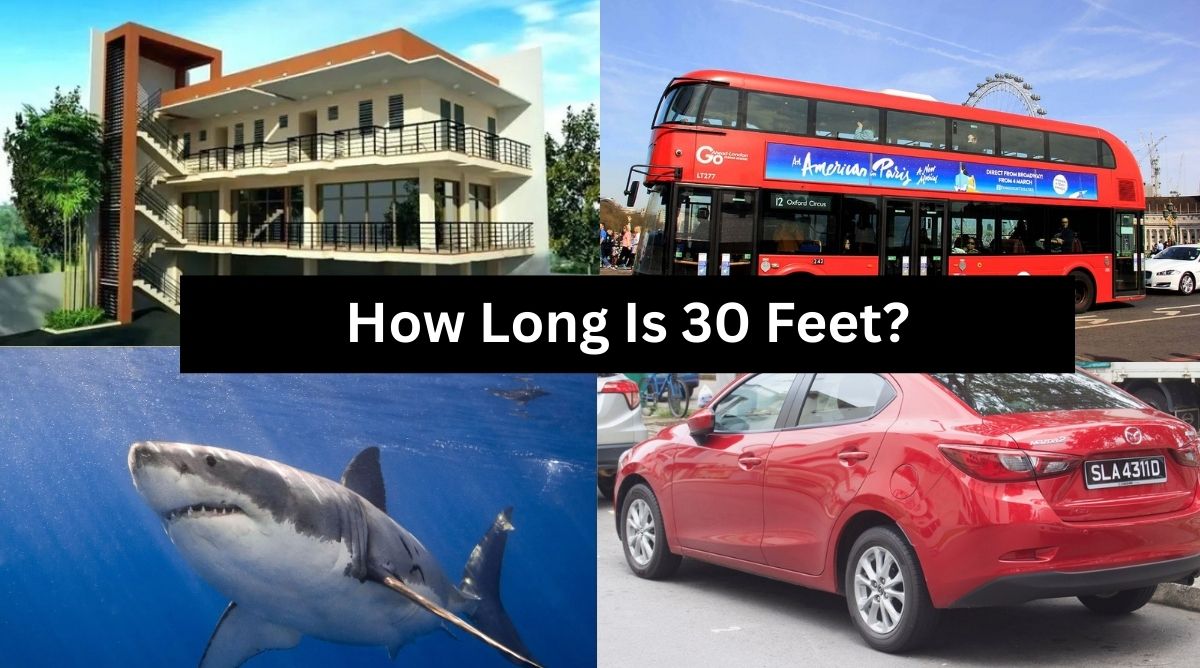
| 2 | A 3-story building | ~30 ft |
| 3 | Half a bowling lane | 30 ft (to foul line) |
| 4 | A London bus (New Routemaster) | 36 ft 10 in |
| 5 | 2 standard sedan cars | ~30 ft combined |
| 6 | 2 great white sharks, nose to tail | ~30–36 ft combined |
| 7 | A telephone pole | ~30–35 ft |
| 8 | 3 table tennis tables | ~27 ft |
| 9 | A tetherball pole | ~10 ft (30 ft total with 3 poles) |
| 10 | A semi-truck sleeper cab | ~30 ft |
| 11 | 3.5 Olympic pool racing lanes | 30 ft (lanes are 8.2 ft each) |
| 12 | Three 10-foot Christmas tree sections | 30 ft |
| 13 | A fire truck | ~30 ft |
List of Things That Are 30 Feet Long or Big
- Half of the Cricket Pitch
- A 3-Story Building
- Half a Bowling Lane
- A London Bus
- 2 Standard sedan cars
- 2x Great White Shark
- A Telephone Pole
- 3x Table Tennis Table
- Tetherball Pole
- A Semi-Trailer Truck Cab
- An Olympic Swimming Pool Width
- Triple the Christmas Tree Height
- Fire Truck
Half of the Cricket Pitch
At 22 yards long, or 66 feet, the cricket pitch is where strategy meets precision. Half of that length, roughly 30 feet, is a critical reference for both batters and bowlers judging their positioning.

A miscalculated step or swing at this distance can cost a wicket or a scoring chance. Understanding how far is 30 feet helps players fine-tune footwork, while bowlers strategize their deliveries to exploit gaps. If you want the complete rulebook on markings, creases, and pitch care, our cricket pitch guide covers it in full.
A 3-Story Building
Three-story buildings, standing about 30 feet tall, are common in dense urban areas because they maximize usable space without requiring elevators. Each floor typically runs about 10 feet, giving flexible options for residential or small commercial use.

This height balances construction cost with comfort, which is why it appeals to both developers and residents. Keeping floor heights around 10 feet each also allows for larger windows and better natural light, which most local building codes support without extra permitting.
Half a Bowling Lane
The halfway point of a bowling lane sits 30 feet from the foul line. It’s the target most bowlers aim for on ball release, since hitting this spot consistently is what promotes accuracy down the lane.

Mastering the release at the 30-foot mark shapes a bowler’s whole approach, encouraging proper technique and consistent throws. Recognizing why this halfway point matters can turn a casual bowler’s game into a more skillful one.
A London Bus
The New Routemaster double-decker, the current icon of London public transport, measures 11.23 meters, or about 36 feet 10 inches long. It carries up to 87 passengers and balances capacity with the tight turns of central London streets.

So what does 30 feet look like in practical terms? It’s just shy of one of these buses end to end, close enough that picturing the bus gives you a nearly exact sense of the distance. The New Routemaster’s hybrid diesel-electric drivetrain and accessible low-floor design have made it a template studied by transit planners in other cities.
2 Standard Sedan Cars
Two sedans parked side by side occupy close to 30 feet of curb space. Since the average sedan runs about 15 feet long, this figure matters directly for how architects and city planners lay out parking lots.

Vehicle length also affects drive-through lane design and traffic flow. Planners who understand this 30 feet visualized measurement can design wider lanes and more efficient parking layouts that improve the experience for everyone using the space.
2x Great White Shark
Adult great white sharks commonly range from about 15 to 20 feet long, so two placed end to end add up to about 30 feet, similar to the length of a school bus or a small yacht.

Marine biologists rely on familiar, relatable comparisons like this to communicate scale to the public. Simplifying technical measurements this way helps reinforce why ocean conservation and habitat protection matter.
A Telephone Pole
Telephone poles commonly stand around 30 to 35 feet tall, supporting phone lines, power lines, and fiber optic cables that keep communities connected.
Many people remember technicians climbing these poles for repairs, a reminder of how much infrastructure quietly keeps communication running.

These structures are a straightforward example of the 30 feet reference point: tall enough to clear traffic and buildings, short enough to be serviced without specialized equipment.
3x Table Tennis Table
A standard table tennis table measures about 9 feet long, so three placed end to end come out to roughly 27 feet, just under the 30-foot mark. This length matters for organizing tournaments and training spaces, since it affects how players move and react during matches.

Standardized table dimensions help event organizers plan layouts that work for both players and spectators during competitive matches.
Tetherball Pole
A tetherball pole typically stands around 10 feet tall, so three of them stacked would reach 30 feet. The pole’s height is what gives the ball room to swing during play.

When you consider how long is 30 feet in this context, it’s really about clearance: proper pole height in parks and playgrounds supports a wider range of playing styles and skill levels.
A Semi-Trailer Truck Cab
A semi-truck’s sleeper cab, the section that includes the hood, cabin, and a bed for long-haul drivers, commonly runs close to 30 feet in length. Day cabs without sleeping quarters are shorter, typically around 20 feet.

This length matters directly for urban planning, since loading dock configurations and parking spaces need to account for it. As cities grow denser, accommodating vehicles this size becomes part of preventing congestion and keeping traffic moving safely.
An Olympic Swimming Pool Width
Olympic and World Championship swimming pools are standardized at 25 meters wide (about 82 feet) with 10 racing lanes, each 2.5 meters (roughly 8.2 feet) wide. Three and a half of those lanes placed side by side add up to close to 30 feet, a useful way to picture the distance if you’ve ever stood at a competition pool.

The 2.5-meter lane width is set by World Aquatics (formerly FINA) to give swimmers enough clearance from each other’s wake, which is part of why competition times stay consistent across venues worldwide.
Triple the Christmas Tree Height
Commercial Christmas trees built for malls and city centers often reach 30 feet, typically assembled from three 10-foot sections. This modular build makes transport and setup far more practical than a single, massive tree.

The extra height allows for dramatic multi-tier lighting displays, which is why these trees become seasonal landmarks in city centers and shopping districts.
Fire Truck
Fire trucks typically measure close to 30 feet in length, a size built to fit the hoses, ladders, and medical equipment firefighters need during emergencies.

The extra length isn’t for show. It allows for quick access to equipment when every second counts during a response.
Practical Applications: 30 Feet in Everyday Life
The 30-foot measurement quietly shapes home design, safety regulations, and parking layouts. Many suburban residential lots run about 30 feet wide, which directly influences house footprints and neighborhood layouts. If you’re comparing this to a typical living room, 30 feet would comfortably fit two to three average rooms end to end.
The U.S. Occupational Safety and Health Administration (OSHA) requires fall protection for construction workers at heights of 6 feet or more in most general industry settings and specifically at 30 feet or higher for certain outdoor advertising and specialty work. Standard parking lot aisles generally measure between 24 and 30 feet wide, which allows enough room for vehicles to maneuver safely between parked cars.
The Science Behind 30 Feet
In physics, a 30-foot drop is a useful reminder of how gravity behaves. An object dropped from this height falls for approximately 1.4 seconds, reaching an impact speed of roughly 30 mph by the time it hits the ground, assuming negligible air resistance.
This straightforward fall illustrates a basic law of motion: gravity accelerates all objects at the same rate regardless of mass, ignoring air resistance. For comparison, a peregrine falcon diving in a hunting stoop can cover the same 30-foot distance in a fraction of a second, reaching speeds that make it the fastest animal on Earth.
Comparing 30 Feet to Other Common Measurements
| Distance | How It Compares to 30 Feet |
|---|---|
| 20 feet | 10 feet shorter; about two-thirds the length |
| 6 feet | Five 6-foot lengths make up 30 feet |
| 100 feet | Just over 3x longer than 30 feet |
| A basketball court | 30 feet is about one-third the length of a basketball court |
Conclusion
Understanding how long is 30 feet helps you visualize distances more accurately in everyday situations, whether that’s a school bus, a 3-story building, or the width of a residential lot. By anchoring this measurement to familiar objects and vehicles, it becomes far easier to picture and apply, whether you’re planning a renovation, following a sports rule, or just satisfying curiosity about a number you saw somewhere.
Conclusion
Understanding how long is 30 feet can help us visualize distances more accurately in our daily lives. Whether it’s the length of a small room, an average car, or a basketball court, this measurement has several relatable contexts. It’s fascinating how this seemingly simple number can impact our perception of space and distance. By using everyday items and familiar references, we can better appreciate the scale of 30 feet.
FAQs
What Car is 30 Feet Long?
Very few production cars reach 30 feet. The closest well-known example is the Packard Royal Streamliner, a one-off custom-built car completed in 2015 by builder Rodney Rucker with design input from Chip Foose. It measures 31 feet 6 inches long and is powered by a supercharged Packard V12 marine engine. It is a modern custom build rather than a mass-produced mid-century model.
How Far is 30 Feet in Miles to Walk?
30 feet equals approximately 0.0057 miles, a distance most people cover in under 10 seconds of walking.
How Big is 30 Feet Compared to a Human?
30 feet is about 5.45 times the height of an average adult human, who stands between 5.5 and 6 feet tall. Stacking five adult humans on top of each other would still fall just short of reaching 30 feet.
How High is 30 Feet?
30 feet is roughly equivalent to two to three stories in a typical building, since a single story generally runs 10 to 12 feet tall.
Is 30 Feet the Same as 10 Yards?
Yes. Since 1 yard equals 3 feet, 30 feet converts exactly to 10 yards, a distance easy to picture on a football field, where it equals one-third of a 30-yard marker.
What Is 30 Feet in Meters?
30 feet converts to 9.144 meters, a figure worth knowing when comparing U.S. measurements to metric specifications used in most other countries.