Basketball Court Dimensions and Marking: A Complete Guide (2026)
A standard basketball court measures 28m (91.8ft) long and 15m (49.21ft) wide, with a minimum height of 7m (22.96ft) for indoor courts. Understanding these measurements is crucial for players, coaches, and enthusiasts aiming to elevate their game.
In this complete guide, we will explore the different basketball court dimensions across high school and professional levels and highlight the markings that define each area.
What is the Total Area of the Basketball Court?
A standard professional basketball court covers an area of 420 square meters, while Basketball England mandates a minimum size of 364 square meters. This applies to both indoor and outdoor facilities.
When accounting for the 2.05-meter run-offs and an additional 2 meters for teams and officials along the sidelines to place basketball equipment, the overall area for a basketball court expands to 677.31 square meters.
Basketball Court Dimensions in Feet
Dimensions of a basketball court can also be expressed in feet. The basketball court dimensions are 91.86 feet in length and 49.21 feet in width. This gives the playing surface an area of 4,520.43 square feet.
If you include run-offs and sidelines, the total area expands to 7,290.5 square feet.
| Basketball Court Aspects | Dimensions in Feet |
| Length | 91.86ft |
| Width | 49.21ft |
| Height | 22.96ft |
| Playing Area | 4520.43ft² |
| Playing Area (including run-off & sidelines) | 7290.5ft² |
| Centre Circle Diameter | 11.81 ft |
| No Charge Arc (from hoop centre) | 4.1 ft |
Also read Badminton Court Dimensions: Size & Layout Complete Guide
Basketball Size in Meters
In the UK, the dimensions of a basketball court measure 28 meters (91.8 feet) in length and 15 meters (49.21 feet) in width. For indoor facilities, the height should be 7 meters (22.96 feet).
| Court Aspects | Dimensions |
| Court Length (International) | 28m |
| Court Width (International) | 15m |
| Court Height (International) | 7m |
| Court Length (other levels) | 26-28m |
| Court Width (other levels) | 14-15m |
| Court Height (other levels) | 7m |
| Centre Circle Diameter | 3.6 m |
| No Charge Arc (from hoop centre) | 1.25 m |
How Long is the Basketball Court?
The standard length of a basketball court is 28 meters. This length is key for professional and competitive play, providing ample space for players to showcase their skills and strategies.
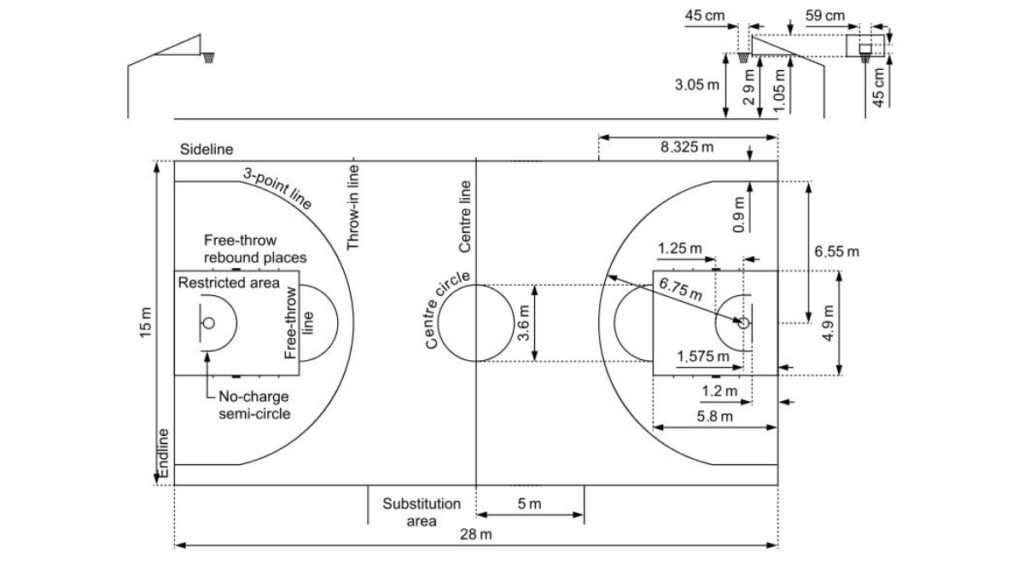
In situations where space is limited, such as in Premier courts, Club, and Community courts, the length can be shortened to 26 meters. This reduction maintains the essence of the game while accommodating various environments.
Smaller venues may arise in urban settings or recreational facilities where large courts are not feasible. Adjusting the dimensions allows for more accessible play without compromising the experience too much.
Basketball Court Dimensions in Yards
A standard basketball court has specific dimensions that are essential for gameplay. The court measures 30.62 yards in length and 16.4 yards in width. This creates a total playing area of approximately 502.31 square yards.
In addition to the playing area, some run-offs and sidelines are often necessary for safety and organization. When these areas are included, the overall dimensions of the basketball court size expand to about 810 square yards.
These additional spaces provide players with room to maneuver and help prevent injuries. The detailed layout ensures that both recreational and professional games can be played effectively.
| Court Aspects | Dimensions |
| Court Playing Area | 502.31yds² |
| Court Length | 30.62yds |
| Court Width | 16.4yds |
| Playing area (including run-offs and sidelines) | 810yds² |
Basketball Court Marking
- Sidelines of Basketball court
- Baseline and Endline of Basketball Court
- Basketball midcourt
- Center Circle of Basketball Court
- Three point line in Basketball Court
- Free throw line of Basketball Court
- Free throw circle in Basketball Court
- Free throw lane lines/keys
Sidelines of Basketball Court
The outer edge of a basketball court is defined by the sidelines, which stretch along the entire length of the playing area. In a regulation full-sized basketball court, these sidelines measure an impressive 28 meters. They run parallel to one another, marking the boundary for out-of-bounds plays.
The sidelines serve a crucial role in the game by helping players and officials determine if the ball has gone out of play. Understanding the sidelines is essential for both strategy and gameplay, as players must be aware of their positioning in relation to these boundaries.
Coaches often emphasize the importance of staying inside the sidelines to maintain control over the game. The sidelines are often adorned with team logos or sponsorships, adding visual appeal to the court. These lines of a basketball court are more than just lines; they are vital components of the sport’s structure.
Baseline and Endline of Basketball Court
The terms “baseline” and “endline” refer to specific areas at both ends of a basketball court, particularly behind the goals, and serve as critical reference points in the sport of basketball, influencing both offensive and defensive gameplay. These lines generally measure 15 meters in length and are crucial in defining the boundaries of play.
The distinction between these terms largely hinges on the direction a team is playing. The endline typically refers to the side of the court that a team is defending. In contrast, the baseline denotes the area at the opposite end, where the team is actively attacking.
Understanding the baseline and endline is essential for players and coaches alike. These terms help in strategizing plays, positioning players, and knowing where to take shots. They are fundamental in determining violations, such as out-of-bounds calls.
Basketball Mid court
The basketball court mid-court line plays a crucial role in the dynamics of the game. It signifies the boundary between the offensive and defensive playing areas, which contributes to the flow and strategy of each match.
Located precisely 14 meters from each endline, this line is essential for determining play and movement during a game. When a team gains possession of the ball, they have a limited time frame to advance it across the mid court line.
Crossing this line is vital to avoid a violation, ensuring that the offense operates effectively within their designated area. The mid court line also serves as a strategic point; teams often set up plays around this area to maximize scoring opportunities.
In addition to its functional use, the mid court line is also a visual marker that players and fans become intimately familiar with throughout the game. Its presence influences both offensive strategies and defensive setups, making it a pivotal element of basketball.
Center Circle of Basketball Court
The Center Circle of the Basketball Court plays a crucial role in the game, particularly during the opening tip-off. This circle has a diameter of 3.6 meters, providing ample space for players to compete for possession right from the start.
Positioned at the center of the court, the circle serves as a clear demarcation for players. It helps establish boundaries during the tip-off, ensuring that the jumpers from both teams have a designated area to contest the ball.
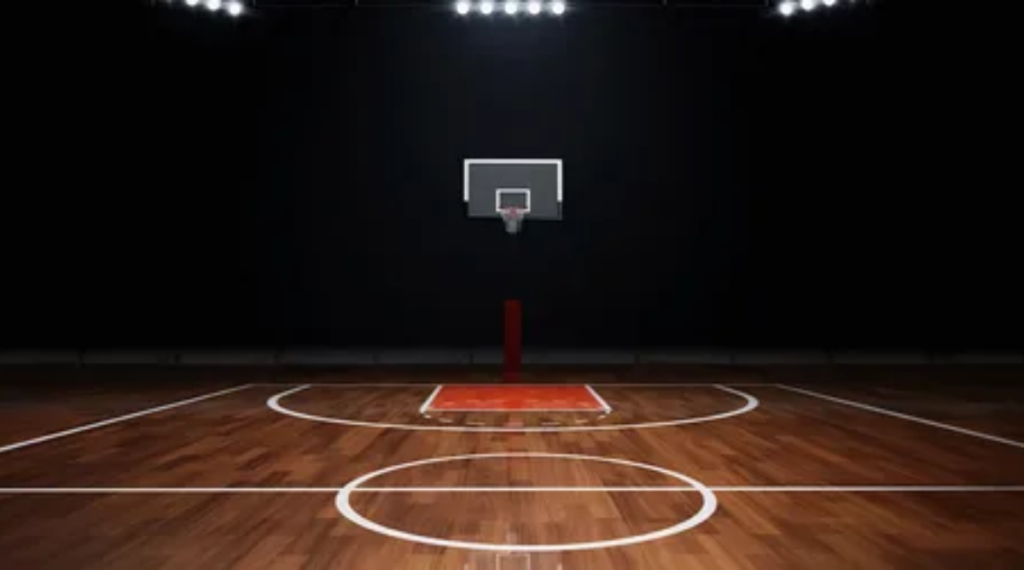
The size of the Center Circle is standardized across professional leagues, promoting fairness and consistency. This uniformity allows players to develop strategies based on a predictable environment.
During the tip-off, the referee tosses the ball high into the air, initiating the game. Players from each team jump simultaneously, showcasing their athleticism and timing. The Center Circle also represents a tactical zone. Coaches may instruct players on positioning and movements leading up to this crucial moment.
Three point line in a basketball court
The three-point line in a basketball court is a crucial feature that defines the boundary for long-range scoring. It consists of arcs extending from each hoop, marking the area where shots are awarded three points.
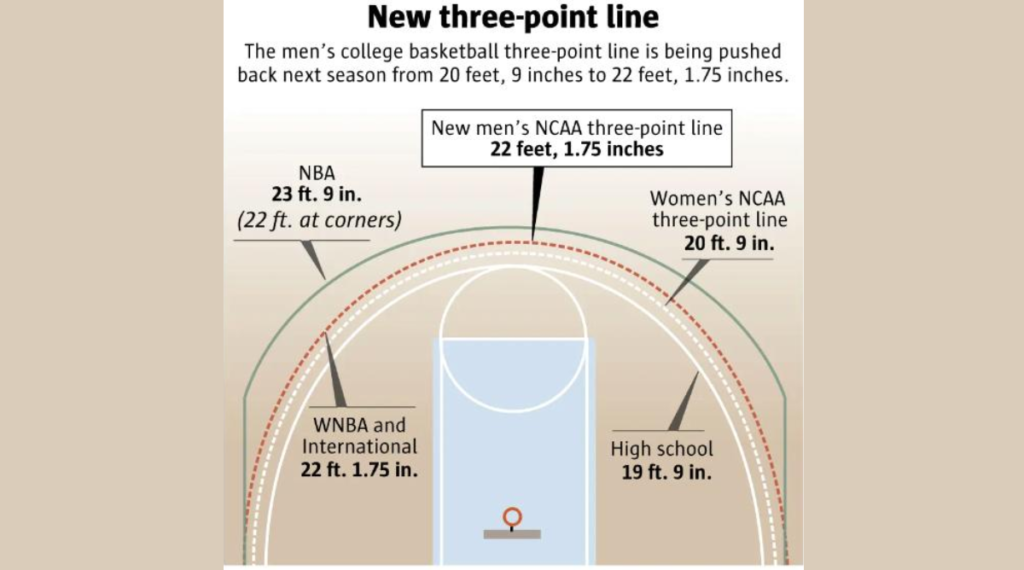
Scoring from beyond this line significantly influences game strategy, as it allows teams to accumulate points more rapidly. When a player makes a successful shot from outside the three-point line, they earn three points instead of the standard two.
The distance from the basket to the three-point line varies based on the level of play. In professional leagues like the NBA, the line is typically set at 7.24 meters (23.75 feet) at the top and 6.70 meters (21.65 feet) in the corners.
In college basketball, the three-point line is a bit shorter, measuring 6.32 meters (20.81 feet). This variation impacts how teams approach their offensive and defensive strategies.
Free throw line of Basketball Court
The free throw line of the basketball court is a crucial part of the game. It is located 4.6 meters, or 15 feet, away from the backboard. This specific distance is designed to create a consistent shooting challenge for players.
When a player is awarded free throws, they must position themselves behind this line. This is done to ensure that every shooter has an equal opportunity to score points without defensive interference.
In professional basketball, this line is clearly marked on the court, usually painted in a contrasting color for visibility. Players often use this mark as a reference point for their shooting technique. Practicing free throws from this line helps athletes develop accuracy and confidence. Ultimately, mastering shots from the free throw line can be a game-changer, especially in close match situations.
Free throw circle in Basketball Court
The free throw circle on a basketball court holds significant importance in the game. Measuring 3.6 meters in diameter, it is identical in size to the center circle, ensuring uniformity in court design. Players must position themselves entirely within this circle when attempting a free throw. This regulation helps maintain fairness and consistency during the shooting process.
The free throw circle is utilized during jump ball situations. Players from opposing teams gather at this circle to contest possession of the ball at the start of the game or after certain stoppages. It serves as a critical area for both scoring opportunities and competitive plays. Its size and designated purpose underscore its role in upholding the structure of the game.
Free throw lane lines/keys
The free throw lane lines run from the free throw line to the baseline, creating an area known as the ‘key’ or the paint. This essential section of the basketball court is critical for both offensive and defensive plays.
The shape and dimensions of the key can fluctuate depending on the level of play, ranging from youth leagues to professional games. However, in 2010, the International Basketball Federation (FIBA) established specific guidelines for the key’s dimensions.
According to FIBA regulations, the key measures 4.9 meters in width and 5.8 meters in length, forming a rectangle that is consistent across international competitions. This standardized size helps maintain uniformity in gameplay worldwide.
The free throw lane lines also help define player movement restrictions during free throws. Players must stay outside the key until the ball is released, ensuring fair play and preventing any advantage for those inside. This area is pivotal for rebounding and executing strategic plays, making it a focal point during games.
Find Cricket Pitch Length In Feet: An Ultimate Guide 2026
Basketball Court Marking in feet & Yards
| Court Marking | Dimensions ft | Dimensions yards |
| Sidelines | 91.86ft | 30.62yds |
| Baseline & Endline | 49.21ft | 16.4yds |
| Midcourt | 45.93ft | 15.31yds |
| Centre Circle | 11.81ft diameter | 3.93yds diameter |
| Three point line | 22.14ft from the basket | 7.38yds from the basket |
| Free throw line | 1.81ft, 15.09ft from the backboard | 3.93yds, 5.03yds from the backboard |
| Free throw circle | 11.81ft diameter | 3.93yds diameter |
| Key/Free throw lane line | 16ft x 19ft | 5.33yds x 6.33yds |
Basketball Goal Types & Dimensions
There are several basketball goal types and dimensions to choose from, including wall-hinged, ceiling-mounted, and free-standing practice systems.
- Basketball Backboard
- Basketball Goal
Basketball Backboards
The dimensions of a basketball backboard are specifically set at 1.8 meters in height and 1.22 meters in width, with a minimum thickness requirement of 19 mm. These backboards can be constructed from either durable timber or a transparent material, providing options for different aesthetics and styles.
For safety purposes, all backboards used in games for players aged under 16 years must feature padding. This padding must cover the areas above the height of the players to prevent injuries during gameplay.
The line markings on the basketball backboard are equally important for proper gameplay. These markings should be 50 mm wide and can be either black or white, depending on the board’s material. The inner shooting rectangle on the backboard is precisely measured to be 0.45 meters by 0.59 meters, ensuring standardization across all basketball courts.
Basketball Goal
The basketball goal, also referred to as a hoop or ring, is a crucial element of the game. Its standard diameter measures 18 inches, equivalent to 45.72 centimeters. This precise size ensures consistency in gameplay, allowing players to develop their shooting skills effectively.
Positioning is equally important. The basketball goal must be installed at a height of 3.05 meters, which is the regulation height recognized by professional leagues worldwide. This height challenges players, making shots more rewarding when successfully executed.
Complementing the goal is the net, usually crafted from durable materials and typically colored white. The net hangs down from the ring, creating an appealing visual when a ball swishes through. To maintain standardization, the net’s length should be no shorter than 45 centimeters, allowing for a graceful descent after each successful shot.
Explore measurements, sizes, and dimensions with ease. Click the link for clear details: Cricket Pitch Dimensions
Conclusion
Understanding basketball court dimensions and markings is essential for both players and coaches to optimize gameplay and strategy. Knowing the specific measurements, from the three-point line to the free-throw area, allows teams to develop tailored plans that leverage their strengths.
Proper court markings ensure fair play and adherence to official rules, which is crucial for competitive environments. By familiarizing yourself with these dimensions, you enhance not only your knowledge but also your performance on the court.
FAQs
What are the Standard Professional Basketball Court Dimensions?
A professional basketball court is 94 feet long and 50 feet wide, ensuring standard conditions across leagues. Key markings like the three-point line and free-throw line are strategically positioned.
Explain a Basketball Court Drawing
A basketball court drawing captures the game’s essence, showcasing physical space and strategic plays. Markings guide player movements and decisions, while the smooth hardwood surface reflects energy from hours of practice, evoking nostalgia and aspiration.
What is the distance of the three-point line from the basket on the basketball court?
The distance of the three-point line from the basket varies, affecting shooting strategies. This uniform setup supports fair competition and practice, vital for player skill development.