Badminton Court Dimensions: Size & Layout Complete Guide
Badminton courts are rectangular areas designed for the sport, featuring a central net. They are marked for singles and doubles, with different boundary widths. Choosing appropriate flooring wood, synthetic, or rubber is vital for safety and performance.
Proper badminton court dimensions ensure fair play, facilitate movement, and enhance safety. Constructing a court to official specifications, including correct net height and clear boundary lines, guarantees an excellent experience for players of all levels.
Standard Badminton Court Size – Official Measurements
The official dimensions for a badminton court designated for doubles play are 13.4 meters in length and 6.1 meters in width. In imperial measures, this translates to 44 feet by 20 feet. These specifications are universally accepted for both professional and recreational badminton courts.
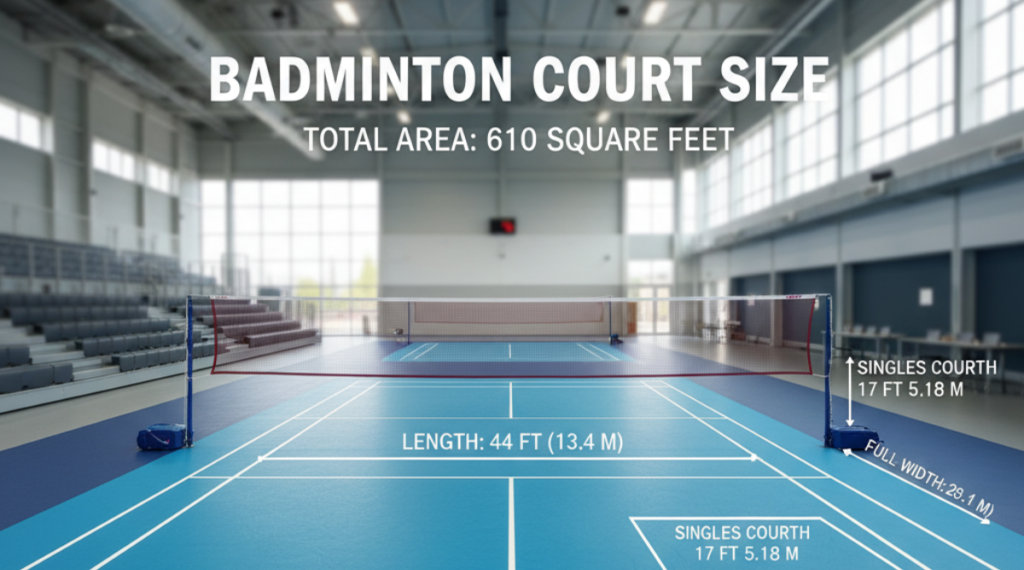
For singles matches, the length of the court stays at 13.4 meters (or 44 feet), while the width is narrowed down to 5.18 meters, equivalent to 17 feet. This adaptation creates a more compact playing area, reflected in a badminton court diagram where the inner sidelines denote the boundaries for singles.
The overall surface area for a doubles court is 81.74 square meters (880 square feet), whereas a singles court encompasses 69.41 square meters (747 square feet). The boundary lines, which are 40 mm (1.57 inches) wide, are included in the total playing area.
The net is set at a height of 1.55 meters (5 feet 1 inch) at the posts and drops slightly to 1.524 meters (5 feet) at the center. These dimensions adhere to the regulations established by the Badminton World Federation, ensuring uniformity in court layouts for training and competitive matches globally.
Badminton Court Dimensions Chart
| Measurement | Metric | Imperial |
| Court Length | 13.4 m | 44 ft |
| Doubles Width | 6.1 m | 20 ft |
| Singles Width | 5.18 m | 17 ft |
| Net Height (Center) | 1.524 m | 5 ft |
| Net Height (Posts) | 1.55 m | 5 ft 1 in |
The table outlines official badminton court dimensions in metric and imperial units. The court length is uniform at 13.4 meters (44 feet) for all matches. However, the width varies: the doubles court measures 6.1 meters (20 feet), while the singles court is narrower at 5.18 meters (17 feet). This differentiation allows for suitable play formats, with singles using the inner boundaries and doubles utilizing the full width.
It also details net height specifications 1.524 meters (5 feet) at the center and 1.55 meters (5 feet 1 inch) at the posts. This design ensures fair competition and consistent play, essential for casual and competitive badminton worldwide.
What is the Badminton Court Layout
A badminton court layout may be described in following areas:
- Court Line Markings and Specifications
- Service Court Dimensions
- Singles vs. Doubles Court Layout
Court Line Markings and Specifications
A badminton court’s boundary lines must be 40 mm wide, usually painted white or yellow for visibility. This ensures compliance with official regulations and maintains professional standards during practice and competition.
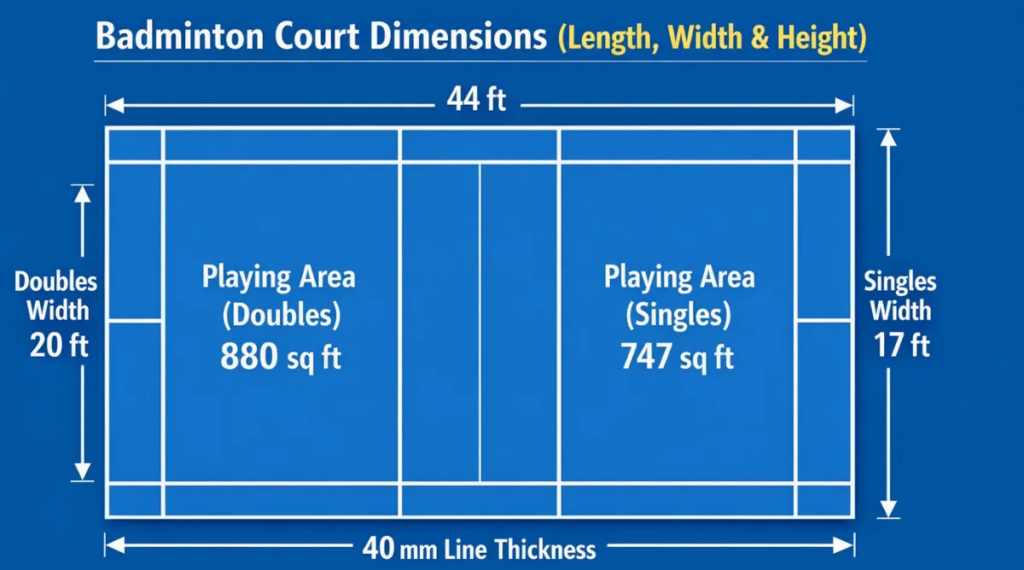
Accurate markings on a badminton court define boundaries and service areas, aiding players’ judgment. Clear lines minimize conflicts during matches and are crucial for tournament courts to ensure consistent gameplay.
For indoor installations, use durable court marking paint or high-quality tape. These materials endure heavy foot traffic, ensuring a non-slip surface and lasting visibility. Well-maintained markings enhance safety and boost player performance.
Service Court Dimensions
The short service line is located 1.98 meters (6.5 feet) from the net, indicating the shortest distance where a serve must legally land. This line is crucial for maintaining precise measurements on the badminton court and ensuring fair competition.
In doubles matches, the long service line aligns with the back boundary. In singles play, an additional long service line is set 0.76 meters (2.5 feet) in from the baseline. This defines the proper service area for singles, preventing excessively deep serves.
A center line runs down the middle of the court, splitting it into left and right service boxes. Serves must be directed diagonally into the opposite service court. These standardized court dimensions help maintain consistent rules and enhance serve precision for players across all skill levels.
Singles vs. Doubles Court Layout
A typical badminton court is sized at 13.4 meters by 5.18 meters for singles matches and 13.4 meters by 6.1 meters for doubles. This increase in dimensions for doubles adds an extra 0.46 meters (1.5 feet) to each side, providing more space for dynamic plays and improved coverage.
The outer alleys, known as tramlines, are exclusive to doubles matches, meaning that any shuttlecock landing in these zones during singles play is considered out. These variations in court size are crucial to the official rules and strategies in badminton.
In doubles, players utilize the full width of the court; however, the boundaries for the service court shift based on the score and player positions. While the back tramline is in play for serves in singles, doubles matches use the long service line as the limit.
Grasping the court dimensions, the distinctions between singles and doubles rules, and the parameters of service lines is essential for players to minimize faults and enhance their precision in competitive scenarios.
Space needed for a Badminton Court
The required space for a badminton court can be discussed in following ways:
- Minimum Space Required
- Recommended Space for Optimal Play
- Multiple Court Configurations
Minimum Space Required
A typical badminton court dimensions are 13.4 m by 6.1 m, but this size alone doesn’t suffice for safe and enjoyable gameplay. Players require additional space surrounding the court to facilitate agile movements and rapid shifts in direction.
The suggested minimum playing area is 14.63 m by 7.32 m (48 ft by 24 ft). This extra room, approximately one meter on each side, enhances safety for both newcomers and casual players.
Adequate clearance around the court is crucial for avoiding injuries. Insufficient space may lead to players colliding with walls or other obstacles during play. The Badminton World Federation (BWF) sets these minimum space requirements to ensure a safe environment for recreational play.
Recommended Space for Optimal Play
To ensure a comfortable and competitive environment for badminton, the court area should measure 17.41 meters by 10.10 meters (57.12 feet by 33.14 feet). This dimension offers adequate safety margins and allows players ample space to move freely, especially during fast exchanges and high-level matches. It conforms to the standard measurements set by BWF, ensuring a secure layout for indoor play.
It is recommended to have a clearance of at least 1.5 to 2 meters behind each baseline for the back court. Along the sides, clearances should be maintained between 1 and 1.5 meters from each sideline. These safety areas are crucial in preventing accidents and facilitating smooth movement.
For indoor courts, a minimum ceiling height of 9 meters (30 feet) is advised, though professional tournaments and advanced training locations often aim for 12 meters (39 feet) to prevent shuttlecock obstruction during high shots. These guidelines are in line with established BWF facility standards, promoting the best possible playing conditions.
Multiple Court Configurations
When setting up several courts, ensure there is at least a 2-meter gap between each playing area. This distance enhances player safety, minimizes disruptions, and facilitates uninterrupted gameplay.
For venues with restricted length but sufficient width, side-by-side court arrangements are most effective. Conversely, end-to-end setups suit elongated and narrow spaces, optimizing the available area.
Typically, standard multipurpose gymnasiums can fit 2 to 4 courts in an organized layout. Implement distinct boundary lines and appropriate spacing to establish a professional court configuration and avoid confusion during peak usage times.
Badminton Court Lines
Understanding badminton court lines is essential for mastering rules and improving gameplay. The boundaries and service lines define official court dimensions used in competitions. This guide outlines the specific positioning of lines on a doubles badminton court and their importance for service regulations, rallies, and matches. It aims to help beginners and players grasp court markings and strategic positioning effectively during play.
- Outer Sidelines
- Inner Sidelines
- Baselines
Outer Sidelines
The external outer side lines, often referred to as outer tramlines or doubles sidelines, outline the complete width of a standard badminton court. Stretching the full 13.41 meters (44 feet) in length, these lines run parallel to each other. The space between the outer sidelines measures 5.18 meters (17 feet), which establishes the official dimensions for doubles play in competitive settings.
In doubles matches, any shuttlecock that lands on or within the outer sideline is considered in play and counts as a valid shot. Conversely, if the shuttle lands outside of this boundary, it is deemed out of bounds, thus ending the rally. These distinctly marked lines assist players in judging their shots accurately while ensuring fairness during the game.
Inner Sidelines
The inner sidelines mark the official width of a singles tennis court, spanning 5.18 meters (17 feet). These lines are parallel to the double sidelines and are set 0.46 meters (1.5 feet) from the outer boundary.
In singles matches, only the space within these inner sidelines is deemed in play; any ball that crosses this line is considered out. Familiarity with the court’s dimensions, markings, and singles regulations is crucial for making precise line calls and ensuring fair competition.
Baselines
The baselines, known as the singles back service lines, are situated at the extreme left and right edges of each badminton court. These lines establish the complete length boundary for a proper court, spanning its full width (20 ft / 6.1 m for doubles and 17 ft / 5.18 m for singles). They are crucial markings in official badminton courts, helping to ascertain whether a shot is in or out.
When the shuttlecock lands beyond the baselines, it is deemed out of play for both singles and doubles matches. In singles, the shuttlecock must land within the opponent’s service box, between the singles sideline and the baseline. The serve is required to travel diagonally over the net into the designated service area; for instance, a serve from the right side must reach the opponent’s left service court.
Grasping the rules associated with the baselines is vital for understanding badminton service regulations, making line calls, and engaging in competitive play.
Professional vs. Recreational Badminton Court Standards
- BWF Tournament Court Requirements
- Recreational and Home Court Flexibility
BWF Tournament Court Requirements
Official competition courts must follow strict BWF guidelines with zero tolerance for discrepancies. Non-compliance could lead to penalties or disqualification. Accurate court dimensions and line markings are essential for international badminton matches.
Venues must provide at least 2 meters of clearance on the sides and 2.5 meters at the ends to ensure player safety and smooth gameplay, adhering to global regulations.
Court surfaces should be dark, typically green or blue, for visibility against white shuttlecocks. Lighting systems must exceed 750 lux for consistent illumination, enhancing fairness and broadcast quality, while minimizing glare for player comfort.
Recreational and Home Court Flexibility
Home basketball courts can function with slightly less clearance while still adhering to official court size standards. A minor reduction in buffer space is acceptable for casual games and practice sessions, as it won’t significantly impact performance.
The height of the ceiling is generally more crucial than the exact side clearance. Players can adjust to confined areas, but a low ceiling can interfere with shooting angles and the overall indoor experience. Sufficient vertical space is essential for maintaining natural gameplay and comfort.
Recreational courts don’t need to be built with professional materials. A smooth, even concrete surface with clear markings is adequate for home training and skill improvement.
Safety should always be a top concern. Even a DIY basketball court requires enough clearance to minimize injury risks during active play. Sufficient space ensures a safer and more enjoyable experience for everyone involved.
Conclusion
Understanding the correct dimensions of a badminton court is crucial for competitive play, player safety, and adherence to tournament regulations. The official size for a doubles court is 44 feet by 20 feet, which serves as the cornerstone of contemporary badminton.
If you’re considering building a badminton court in your backyard, a professional indoor venue, or a training area, adhering to the official guidelines set by the BWF guarantees precise gameplay and durability. In addition to the court’s dimensions, proper markings, adequate ceiling height, and sufficient clearance space are vital to ensure safe movement and maintain high levels of performance during competition.
FAQs
Who invented badminton?
Badminton traces its origins to India in the 1860s, where it was known as ‘Poona.’ British army officers stationed there embraced the game. Upon returning to England, they introduced it to country estates. Subsequently, they formalized the rules, shaping badminton into a competitive sport.
How is badminton different from other racquet sports?
Badminton stands apart from other racquet sports because it uses a conical shuttlecock instead of a round ball.
What are the dimensions of a badminton court?
For doubles matches, a standard badminton court is 13.4 meters in length and 6.1 meters in width (which is equivalent to 44 feet by 20 feet). In singles play, the court retains the same length but is reduced to a width of 5.18 meters (17 feet). These official measurements are recognized globally.
How much space is needed for a badminton court?
The essential area needed for basic play is 14.63 meters by 7.32 meters (48 feet by 24 feet). For enhanced safety and adequate clearance for players, an ideal space size is 17.41 meters by 10.10 meters (57.12 feet by 33.14 feet).