Dollar Bill Dimensions: Size, Height (2026)
Dollar bill dimensions are useful for comparing currency sizes, measuring wallets, creating crafts, or checking printing accuracy. This guide explains the exact size of a U.S. dollar bill in simple words, making it easy for beginners to understand.
You will also learn about U.S. dollar bill size, bill measurements, paper currency dimensions, U.S. currency, and wallet fit, along with practical facts that answer common questions. You’ll understand why every American bill shares the same dimensions, how those measurements are used in everyday life, and what details matter most when handling or comparing paper money with confidence.
How Long is a Dollar Bill
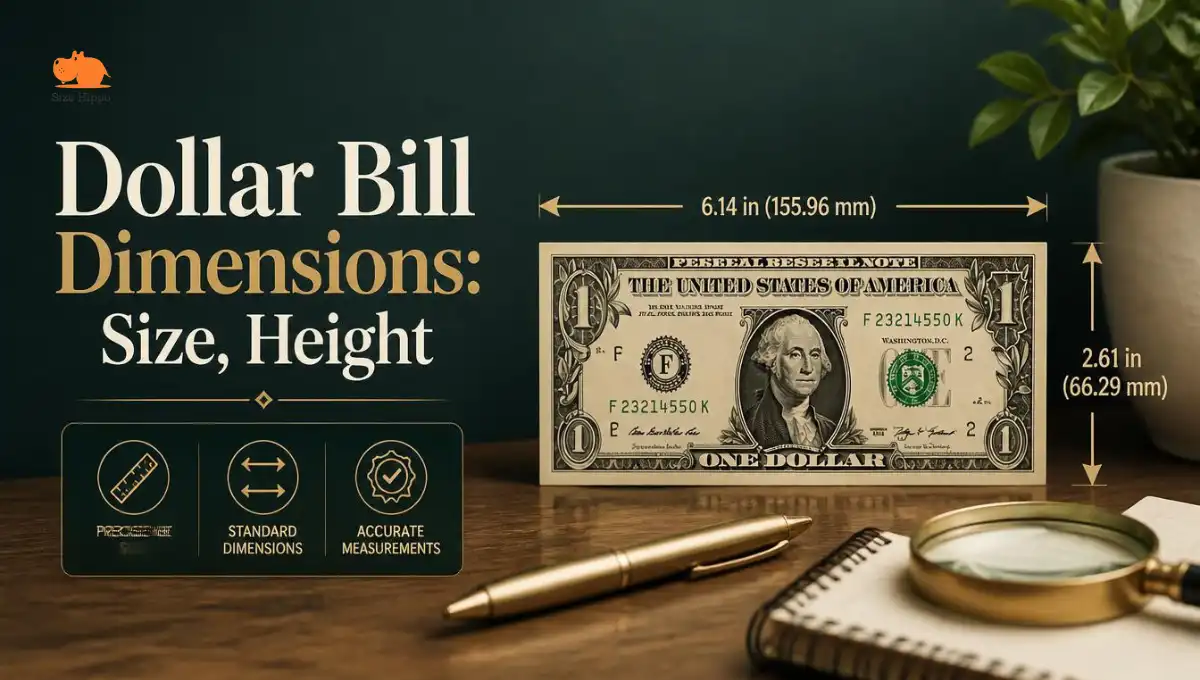
A common question many readers search online is, “What are the exact dollar bill dimensions?” A U.S. dollar bill has a fixed length of 6.14 inches (15.6 cm) and a width of 2.61 inches (6.6 cm).
These standard dollar bill size measurements are the same for all modern U.S. paper currency, making it easy to recognize and use in daily transactions. If you are looking for accurate dollar bill length and width in inches, this size has been consistent for many years to support machines like ATMs and vending systems.
Understanding these exact dollar bill dimensions in simple terms can help in comparisons, educational content, and even creative projects where precise measurements matter.
How Tall is a Dollar Bill
Understanding the dimensions of a dollar bill is useful for education and practical use. A U.S. dollar bill measures 2.61 inches (6.63 centimeters) tall, a uniform size for all current bills.

This standard height aids in comparing small items and ensures efficient storage, counting, and printing. It is slightly taller than a business card but smaller than most smartphones. Knowing these dimensions benefits students, collectors, and designers needing precise references.
Dollar Bills Dimensions in Different Units
A dollar bill measures over 6 inches long and 2.5 inches high, slightly longer than a credit card. In metric, this is about 15.6 cm by 6.6 cm. Stacking 10 bills equals roughly 1 millimeter in thickness, while 100 bills reach about half an inch.
These comparisons aid in visualizing dollar bill dimensions, benefiting students, educators, and designers needing quick size references for projects or displays.
A Quick Reference Table.Chart
| Feature OR Dimensions | Imperial | Metric |
| Length | 6.14 inches | 156 mm |
| Width | 2.61 inches | 66.3 mm |
| Thickness | 0.0043 inches | 0.109 mm |
| Weight | 0.035 ounces | 1 gram |
Are All Dollar Bill Dimensions the Same?
This question may be addressed in the following 2 ways:
- Historical Dollar Bill Size
- One-size-fits-all U.S. currency
Historical Dollar Bill Size
American paper money was produced in different sizes before 1929, which often created inconvenience for everyday use. These larger notes were commonly known as “horse blanket currency” because they were too big to fit comfortably in standard wallets. Some of these bills measured up to 7.4 by 3.1 inches, making them nearly 30% larger than modern U.S. notes.
This period marked a major shift in currency design. The Treasury introduced a standardized size for all paper money to improve efficiency. Smaller bills reduced production costs and increased durability in daily circulation.
The U.S banks benefited from easier storage of the money, as more notes could fit within the same space. This decision brought uniformity and convenience, ultimately modernizing American money and setting the standard still used today.
One Size Fits All U.S. Currency
The U.S. Federal Reserve adopted this uniform approach to improve efficiency and usability. ATMs operate smoothly without needing adjustments for different note sizes.

Every denomination of U.S. currency shares identical dimensions, which means a $1 bill is the same size as a $5, $10, $20, $50, or $100 bill. This consistent sizing system highlights a distinctive feature of the United States currency design.
Vending machines can accept any bill without complications. Wallets also remain simple, as users do not need separate compartments for various denominations. Mass production becomes faster, more cost-effective, and highly streamlined when every bill follows the same standard dimensions.
Dollar Bill Thickness & Stack Height
Dollar Bill Thickness
A single dollar bill measures only 0.0043 inches thick, making it extremely thin and lightweight. It is even thinner than two sheets of standard printer paper. It feels stronger and more durable when you hold it.
United States currency is not made from ordinary wood pulp paper. It is crafted from a special blend of 75% cotton and 25% linen. This combination gives the bill a firm texture and long-lasting quality.
The dollar bill’s unique material shows its strength. It can withstand nearly 4,000 folds before tearing, which is far more than standard paper can manage.
Stack Calculation/Height
When you stack 10 dollar bills, the total thickness is about 0.43 millimeters, which is almost unnoticeable to the eye. Increasing the count to 100 dollar bills creates a stack of approximately 0.43 inches, still less than half an inch tall.
The concept becomes more interesting with larger amounts. A bundle of 1,000 one-dollar bills forms a stack around 4.3 inches high, similar to the height of a standard coffee mug. When you scale this further, 10,000 dollar bills reach nearly 43 inches, which is about 3.5 feet tall.
This simple stack calculation of a dollar bill? helps readers easily visualize cash volume, making it useful for educational purposes, financial awareness, and real-world comparisons.
Dollar Bill Dimensions by Denominations
The dimensions of a U.S. dollar note can be explained with respect to common denominations of a dollar bill and rare and discontinued bills.
Common Denominations
1$ Bill Dimensions: The $1 bill measures 6.14 x 2.61 inches and is the standard U.S. currency size. It features George Washington on the front, based on Gilbert Stuart’s Athenaeum Portrait.
The reverse displays the Great Seal, including the American eagle and an unfinished pyramid with an all-seeing eye.
This design reflects national identity and carries historical significance. Recognizing these features enhances familiarity with the one-dollar bill and the overall understanding of U.S. currency design.
5$ Bill Size: The $5 bill maintains standard U.S. currency size, featuring Abraham Lincoln’s portrait and the Lincoln Memorial. Recent series include purple accents for enhanced security and visual appeal, improving counterfeiting protection.
$10 Bill Measurement: The $10 bill maintains standard U.S. currency measurement for easy recognition. It features Alexander Hamilton on the front, enhancing its historical significance, while the reverse displays the U.S. Treasury building, symbolizing the financial system. It is the only U.S. bill without a president’s portrait.
$20 Bill Dimensions: The $20 bill has a consistent size and has evolved in design. Andrew Jackson’s portrait replaced Grover Cleveland’s, adding historical importance. The reverse features the White House, enhancing its visual appeal. Widely circulated, it plays a significant role in American transactions.
$50 Bill Size: The $50 bill showcases Ulysses S. Grant and the U.S. Capitol, with a distinct green and peach design that aids recognition and prevents counterfeiting. Its secure features and professional look enhance usability in transactions.
100-Dollar Bill Dimensions: The design features Ulysses S. Grant’s portrait, highlighting historical significance. The reverse showcases the U.S. Capitol, symbolizing governance and heritage. Chosen green and peach tones enhance security and deter counterfeiting.
These elements combine aesthetic appeal with functional authenticity, ensuring trust in circulation. The bill adheres to standard $100 dimensions, maintaining consistency with U.S. currency standards.
Rare and Discontinued Dollar Bills
The $2 bill remains in circulation but is rarely seen in daily use. It features Thomas Jefferson on the front and the Declaration of Independence signing on the back. Many mistakenly believe it’s discontinued, but it’s still legally issued. Due to its low circulation, it is popular among collectors and currency enthusiasts.
Rare U.S. currency notes like the $500 bills to $10,000 bills were withdrawn in 1969. These notes, sized 6.14 x 2.61 inches, primarily facilitated large bank transactions rather than everyday use. The Federal Reserve eliminated them to combat illegal activities and organized crime.
Nowadays, collectors and historians highly value these discontinued notes for their rarity and historical significance. Interest remains strong among currency enthusiasts who explore the unique histories of old U.S. banknotes.
The Rare and discontinued dollar bills include unique U.S. currency pieces, such as the $10,000 bill featuring Salmon P. Chase. Printed from 1928 to 1945, these limited notes number only a few hundred today. Mostly found in museums or with collectors, their value far exceeds their face value, making them prized historical artifacts.
The $100,000 gold certificate featured Woodrow Wilson and was never circulated publicly. Used solely for internal Federal Reserve transactions, its rarity and historical significance make it a unique piece of American currency. Despite its high value, it maintained the standard size of regular bills, emphasizing its unusual status among discontinued dollar bills.
Conclusion
A dollar bill measures over 6 inches long and 2.5 inches high, slightly longer than a credit card. In metric, this is about 15.6 cm by 6.6 cm. Stacking 10 bills equals roughly 1 millimeter in thickness, while 100 bills reach about half an inch.
Since 1929, these measurements have remained constant through wars, economic shifts, and technological advances. That stability reflects the dollar’s role as a global standard.
These comparisons aid in visualizing dollar bill dimensions, benefiting students, educators, and designers needing quick size references for projects or displays.
FAQs
What are the dimensions of a dollar?
A U.S. dollar bill has dimensions of 6.14 inches in length and 2.61 inches in width, which converts to 156 mm by 66.3 mm in metric. Its thickness is 0.0043 inches, equivalent to 0.109 mm. All denominations share these identical specifications.
What does a $10,000 bill look like?
The $10,000 banknote displayed the image of Salmon P. Chase, who served as Treasury Secretary during Lincoln’s presidency. It adhered to the typical dimensions of 6.14 x 2.61 inches, just like regular bills. On the front, you could see Chase’s portrait along with the green Treasury seal and serial numbers.
What is the size of a $100 Bill?
The $100 bill measures 6.14 x 2.61 inches, which is the same as every other U.S. banknote. Even though it holds the highest value among commonly used currency, its dimensions match those of the $1 bill. The only differences lie in the design, color, and security elements, not in size.